

Most Australian libraries feel the yearly pressure of an ever-expanding collection. There’s not enough space to properly store books and shelve them in ways that encourage patrons to browse and help them find resources they need more easily. How can libraries optimise their limited space without encroaching on other areas, such as reading areas?
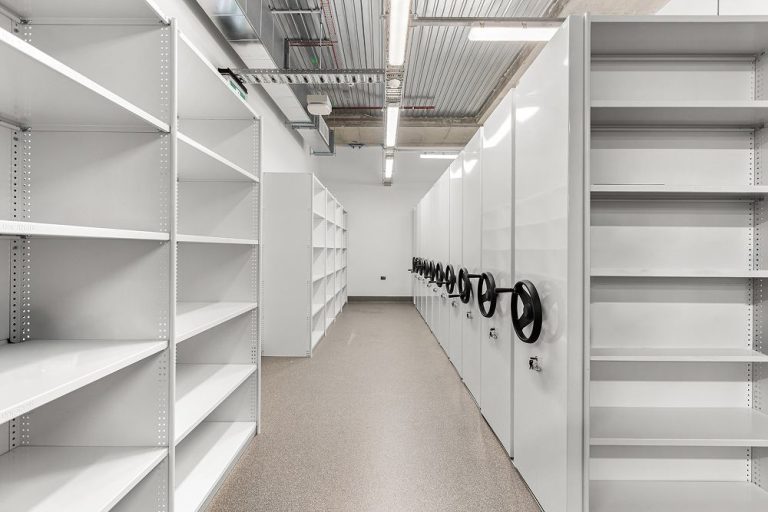
Enter high density mobile shelving for the storeroom. Put your bulk storage on tracks, take out the permanent aisles between every run, and you can hold far more collection in the same room, with IntraSpace clients gaining up to 60% more capacity without expanding their footprint.
In this guide, we’ll cover how these systems work, which track type suits your building, and what you’ll need to settle before installation.

Why Library Collections Outgrow Their Space
Static shelving carries a fixed overhead that’s easy to overlook: every run needs its own aisle permanently, whether anyone’s standing in it or not. In a stack room, that can mean close to half your floor area is walking space rather than storage.
For a public library, the cost lands on the parts of the service your community actually sees. Programming and reading areas shrink first because they’re the flexible space.
Local studies and archive material usually go next, off to an external store, which turns a same-day request into a week’s wait and adds a retrieval cost to every enquiry.
Special collections face a sharper version of the same problem. They’re the material least suited to being moved, and they’re usually in the building you can’t extend.
What Is Mobile Shelving and How Does It Work?
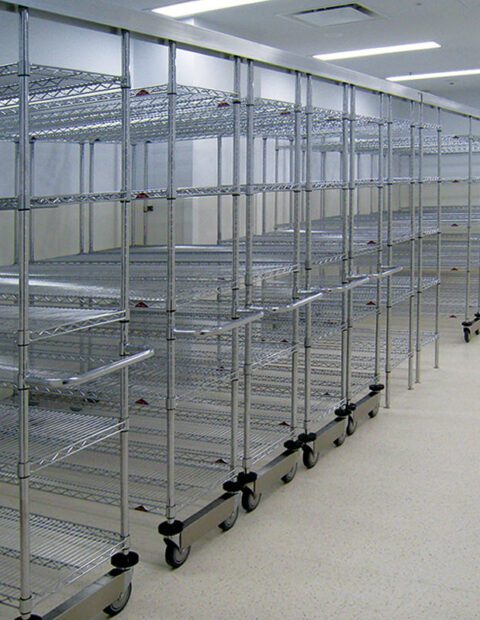
Mobile shelving, also called compact shelving or a compactus, mounts your shelving bays onto tracks so they move together. Instead of an aisle for every run, you have one or two working aisles that open as needed, and when the bays are closed, the floor space used for walkways becomes storage.
In a library, mobile shelving belongs in the back-of-house storerooms that hold bulk, archive and overflow stock, while the collection your patrons browse stays on the main floor in static or convertible library shelving.
The gains scale with how many runs you have. A room carrying ten static runs is also carrying ten aisles; the same room on a mobile system carries one
IntraSpace supplies these systems under the FileStor Mobile Shelving range, which sits inside the broader Shelving category alongside the static systems it often works with.

How Much Extra Capacity Can Libraries Realistically Gain?
IntraSpace clients have reported up to 60% more storage capacity within the confines of their existing storage area.
A school library client put it more plainly: “It is high quality, attractive, and aesthetically pleasing as well as functional. The unit has a lot of capacity while taking up minimal space.
What you’ll gain in your building depends on run length, aisle count and ceiling height, which is why a configuration gets drawn against your floorplan rather than estimated from a catalogue.
Choosing the Right Track System for Your Building
Settle the track first, because it determines what’s possible with the floor underneath everything else.
New builds and major refurbishments
If you build or fully replace the floor, you can set the track in or fix it to the structure from the start.
The Filestor Base Mounted Track System carries the track on a base frame, giving you a level running surface independent of the existing floor. Filestor Fixed-Track-On-Floor fixes straight to the slab, which suits new construction where floor preparation is already in scope.
Lock either option in early. Retrofitting a fixed track into a finished library is a far bigger job than specifying it during design.
Retrofitting heritage and older library buildings
Older council libraries, state library reading rooms and heritage-listed buildings often can’t accept floor cutting at all.
The Filestor Low Profile Track System is built for exactly these situations. IntraSpace states that low-profile tracks don’t require fixing and can sit on top of most existing floor surfaces, with no preparation needed. There’s no heavy base either, which keeps floor loads to a minimum — something worth knowing in any building with a timber upper floor or an unclear structural history.
Manual or Electronic: Matching Movement to How the Collection Is Used
Electronic mobile shelving for busy working collections
If your collection is accessed constantly, or the runs are long enough that moving them by hand becomes a job in itself, electronic mobile shelving opens the aisle you need from a control panel.
The safety case has a strong design. Optical sensors and resistance monitoring eliminate the risk of anyone being caught in the unit, which matters in any space the public can walk into.
It also gives you multiple security levels for individual users, so you can zone particular aisles and bays for staff or specific groups, with all access tracked by the software. For a special collections reading room or a council records store, that access log is often what decides who gets in.
Other Shelving for Library Storerooms
A good deal of any collection is the wrong shape for book shelving. Boxed archives, folio volumes, map cases, framed material and donated collections still in their original containers all sit awkwardly on a standard bay.
FileStor Universal Shelving and FileStor Longspan are built for general storage, boxes, and bulky and odd-shaped items, including archives, which makes them a good fit for the static runs in a library storeroom.
Once density increases, retrieval becomes your new constraint. Wire Shelving Accessories and Label Holders keep a denser store navigable, so staff aren’t opening three aisles to find one box.
Planning Your Installation
Five things to settle before anything else is specified.
Floor loading. Compact shelving concentrates the weight of your collection into a smaller footprint, which is the whole point and also the main structural question. In an older building, or above ground level, get an engineer’s confirmation early rather than late.
Access frequency. How many people need to be in the system at once determines how many aisles it has to open, and that decides whether manual or electronic is right for you.
Safety and access control. Any system that the public can access needs its safety features confirmed based on how you supervise the space, using electronic system’s sensors and user-level zoning as your reference point.
Room and collection dimensions. Shelf depth and height depend on the collection, so measure both the material and the room. The library shelving range covers public-facing specifications alongside the storeroom systems.
Growth allowance. Specify your collection’s future needs over the next five to ten years, not its current state.
Mobile Shelving Across Library Types
Public and community libraries see the most visible return because moving bulk stock onto mobile shelving in the storeroom hands the public floor back to programming, study areas and browsing.
University and state library special collections use mobile systems for the density, the environmental control that comes with a smaller volume, and the access logging restricted material requires.
School libraries are usually working with a fixed room and a growing collection, which is precisely what IntraSpace’s school library client was describing.
Council local studies and records archives face the most acute version of the problem, since the material is irreplaceable, frequently requested, and expensive to hold off-site.
Art galleries hold collections that can’t be stacked in boxes or packed tight, so storage has to protect each work and still keep it easy to retrieve. At Stanthorpe Library and Art Gallery in Queensland’s Southern Downs, IntraSpace supplied and installed hanging art storage in two sections of the gallery.
Each panel is double-sided, and several can be accessed at once, which speeds up retrieval. The system runs on an overhead rail instead of floor tracks, so trolleys move without interruption, dust has less chance to build up, and there’s no trip hazard, which also suits older buildings with uneven floors. When the collection grows, the panels can be set closer together and more can be added.
The Libraries Projects portfolio covers work across all of these sectors, from Parramatta Library and Stanton Library through to RMIT University’s Swanston Library, Monash Public Libraries and Stanthorpe Library and Art Gallery.
A Complete Library Fit-Out, Not Just Shelving


Mobile shelving looks after the storeroom, and IntraSpace also fits out the front of the library where your patrons spend their time.
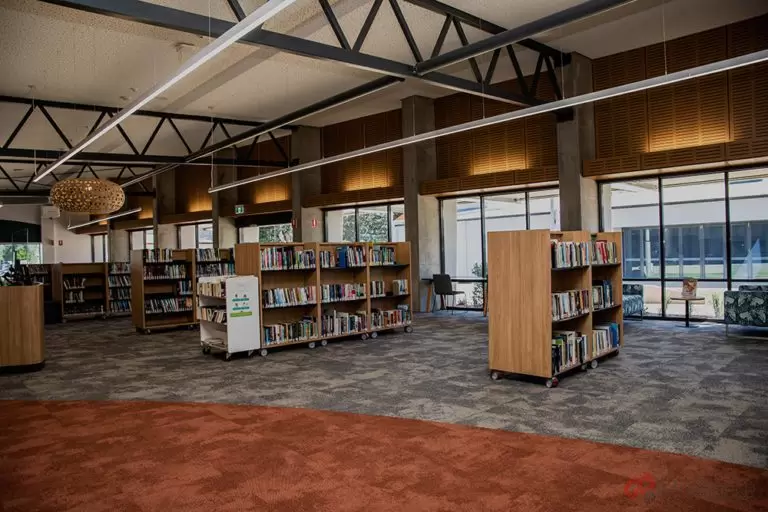
Library Shelving covers the main collection on the public floor, from single-sided convertible shelving along the walls to double-sided mobile convertible shelving with castors that can be moved to suit events and layout changes.
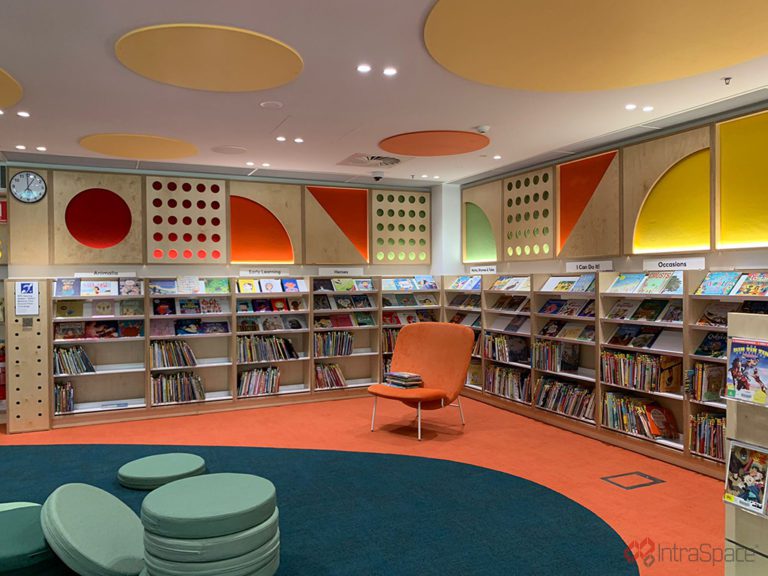
Library Furniture covers the rest of the public-facing range, Library Trolleys handle returns and reshelving between the stack and the floor, and Circulation Desk Designs set the point where your staff and readers meet. Specify them together, and the workflow stays consistent from delivery through to loan.
Mobile Shelving for Australian Libraries
IntraSpace has partnered with public libraries, galleries and archives for more than 22 years, delivering practical solutions across the sector.
The company designs, specifies and installs, is ISO 9001, ISO 14001 and ISO 45001 certified, and supplies libraries through Procurement Australia Contract 2706/0848 for Library Collections, Furniture and Equipment, plus MAV, Local Buy and LGAT arrangements — taking a significant amount of tender administration out of council and school library projects.
PLAN YOUR INSTALLATION: Send Us Your Floor Plans
Share your floor plans or room dimensions, and we’ll draw a mobile shelving configuration against your actual space, confirm the right track system for your building, and quote it as a complete installation.